What is Pinterest SEO for artists? Pinterest SEO is the practice of using keywords in your profile, board names, board descriptions, Pin titles, and Pin descriptions so that Pinterest’s search algorithm can find your work and show it to people already searching for art like yours. Unlike social media, where posts disappear quickly, Pinterest Pins can drive traffic and discovery for months or years after you publish them.
There’s a particular kind of quiet that comes with making art. The focus, the layers, the slow emergence of something from nothing. What doesn’t always feel quiet is trying to share that work with the world.
I came back to painting after years away, years spent building a living, teaching, consulting. When I returned to the canvas, I found myself asking the same question my clients ask me every day: how do people actually find my work?
The answer, for me and for the artists I work with, is Pinterest.
But not Pinterest used casually, rather Pinterest used strategically, with SEO.
If you’ve ever wondered why some artists seem to get consistent traffic from Pinterest while yours sits quiet, this is the article for you. Pinterest SEO is not complicated, but it does require understanding how the platform actually works, and most artists skip the fundamentals. New to Pinterest altogether? Start with my beginner’s guide to Pinterest marketing for artists for the full overview, then come back here, because SEO is the engine that makes the rest of it work.
Let’s fix that.
What Makes Pinterest Different From Social Media
Before we get into the SEO specifics, it’s worth understanding why Pinterest behaves differently from Instagram, Facebook, or TikTok, because this changes everything about how you use it.
Pinterest is not a social media platform. It is a visual search engine.
When someone opens Instagram, they see what’s new. When someone opens Pinterest, they search for what they want. They type in phrases like “abstract watercolor painting,” “original art for home,” or “small painting for bedroom wall”, and Pinterest shows them results based on relevance, not recency.
This means a Pin you create today can surface in someone’s search six months from now. A year from now. Potentially longer. The platform is designed for discovery over time, not for the endless content treadmill.
For artists, this is calmly revolutionary. You don’t need a massive following, or to post daily. You need your work to be findable, and that’s exactly what Pinterest SEO makes possible.
As I always tell my clients: Pinterest isn’t about chasing attention. It’s about creating a clear path for the right people to find you, and your art, over time.
How Pinterest Search Actually Works
Pinterest’s algorithm uses several signals to decide which Pins to show for any given search. Understanding these signals is the foundation of Pinterest SEO.
Keywords
Pinterest reads the text around your images to understand what they’re about. It looks at your profile, your board names, your board descriptions, your Pin titles, and your Pin descriptions. The keywords you use in these places determine when and where your Pins appear in search.
If your Pin title says “New Work” and your description says “Feeling inspired today!” Pinterest has almost no information to work with. If your Pin title says “Original Watercolor Painting – Abstract Art for Home” and your description contains natural, relevant phrases about the medium, style, and subject, Pinterest can categorize it accurately and serve it to the right searchers.
Think of Pinterest like a studio assistant trying to organize your work. If every piece goes into a box marked “Art” or “Inspiration,” the assistant has to guess where it belongs. But if one box says “Abstract Acrylic Paintings,” another says “Botanical Watercolor Art,” and another says “Small Paintings for Sale,” the work is much easier to sort, and find.
Visual Search
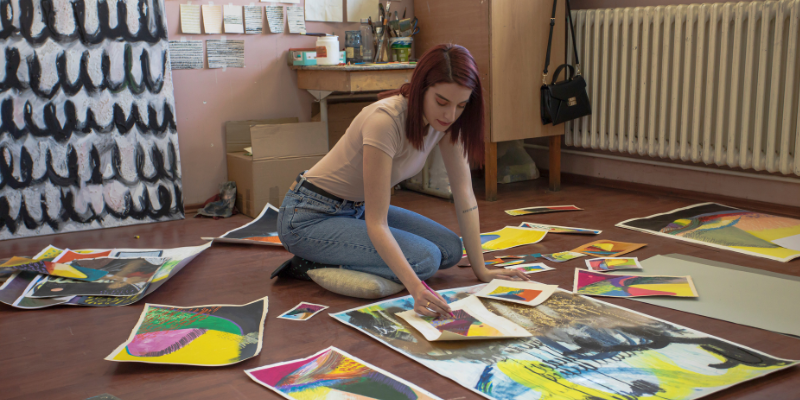
Pinterest also reads your images directly using visual recognition technology. The colors, shapes, composition, and subject matter of your image all contribute to how Pinterest categorizes your Pin. This is why image quality matters, and why the same painting photographed clearly on a neutral background will outperform a dark, blurry shot every single time.
You can read more about how Pinterest’s visual search works in my article on how color can help your Pins rank higher.
Domain Quality
Pinterest pays attention to where your Pins link. A Pin that links to a well-maintained, regularly updated website with original content, for example: your portfolio, your blog, your shop, will generally outperform a Pin that links to a neglected or thin page.
This is one of the reasons building your website alongside your Pinterest presence matters. Each Pin is a pathway back to your work. The better the destination, the more Pinterest trusts and distributes your Pins.
Discover how Domain Quality is a key factor of the Pinterest algorithm in my article on unveiling better visibility.
Engagement Signals
Saves, clicks, and close-ups (when you open up a Pin) all signal to Pinterest that a Pin is worth showing to more people. This is why the quality of your images and the clarity of your descriptions matter beyond just keywords; they need to earn the engagement that tells the algorithm your work is worth distributing.
Where to Put Keywords on Pinterest
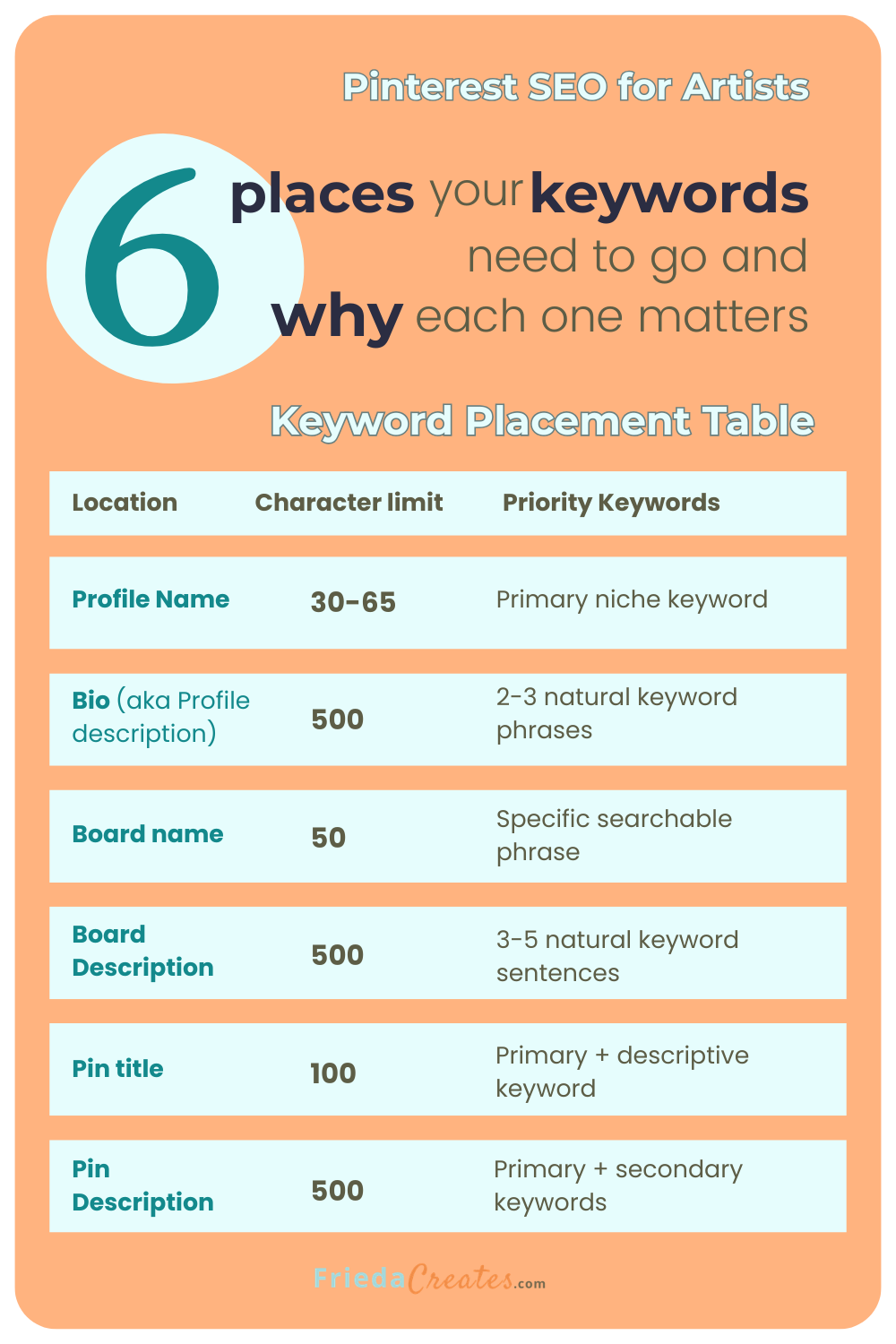
Pinterest SEO works best when keywords appear consistently across multiple locations. Here’s where to focus, in order of importance.
1. Your Pinterest Profile
Your display name and bio are searchable. Include your primary keyword phrase here. Instead of just “Frieda | Artist and Marketer,” try “Frieda | Pinterest Marketing for Artists | California Painter.” The bio should clearly state who you help, what you do, and include one or two natural keyword phrases.
2. Board Names
This is where most artists make their first and biggest mistake. Board names like “Art,” “My Work,” “Inspiration,” or “Pretty Things” are invisible to Pinterest’s search algorithm. No one is searching for those phrases.
Board names should describe exactly what’s in the board, such as using phrases people actually search for. “Original Watercolor Paintings,” “Abstract Acrylic Art,” “Small Original Paintings for Sale,” “Art for the Home”; these are searchable. “My Art” is not.
If your current boards have vague names, then renaming them is the single highest-leverage change you can make today. I walk through exactly how to do this in the Board Starter Guide.
3. Board Descriptions
Each board has a description field that most artists leave empty. Please don’t. Instead, write 2-3 sentences that naturally include the keywords someone would use to find content in that board. Be sure to use full sentences, not a list of keywords (known as keyword stuffing), because Pinterest reads for meaning and context, not just matching phrases.
Here’s an example of a watercolor board description:
“Original watercolor paintings exploring color, depth, and the quiet space between stillness and movement. Watercolor artwork that is layered, intuitive, and guided by energy and place. Watercolor painting inspiration for collectors and art lovers seeking original art for the home.”
4. Pin Titles
Pinterest added the Pin title field as a dedicated SEO signal, and it’s one of the most underused tools available. Your Pin title should lead with your primary keyword, followed by a descriptive phrase.
Format: [Primary keyword] — [Descriptive phrase]
Before: “New painting from my latest collection.”
After: “Original floral watercolor painting with spring garden colors, botanical wall art for collectors.”
The second version gives Pinterest medium, subject, inspiration, style, and use. The first gives very little for the algorithm to work with.
Here are a few more examples:
- “Original Watercolor Painting, Abstract Art in Blues and Greens”
- “Pinterest Board Strategy for Artists, How to Name Your Boards”
- “Small Original Acrylic Painting, Art for a Statement Wall”
Titles can contain up to 100 characters, but the first 60 characters are viewable in the home feed and the best place to include the primary keyword. The title appears in bold below your Pin in feeds and is the first thing a searcher reads.
5. Pin Descriptions
Pin descriptions are where you have plenty of space to work with, up to 500 characters. This is your opportunity to weave in secondary keywords naturally, tell the story of the piece or the content, and include a destination reference.
A strong Pin description for an art Pin:
- Opens with the primary keyword
- Includes medium, subject, and dimensions
- Tells a brief story about the piece
- Ends with 2-3 keyword phrases
- Include a CTA such as, “View my latest watercolor paintings.”
Use keywords naturally. Pinterest’s algorithm has become sophisticated enough to recognize keyword stuffing, a list of search terms piled into one sentence without meaning. Write for the human reader first. The keywords should be woven throughout the description in a way that makes sense.
Keyword Placement Table, Pin or Save
Pinterest Keywords for Artists: How to Find Them
You don’t need a keyword tool to do Pinterest keyword research because Pinterest tells you exactly what people are searching for, if you know where to look.
Method 1: Pinterest Search Bar
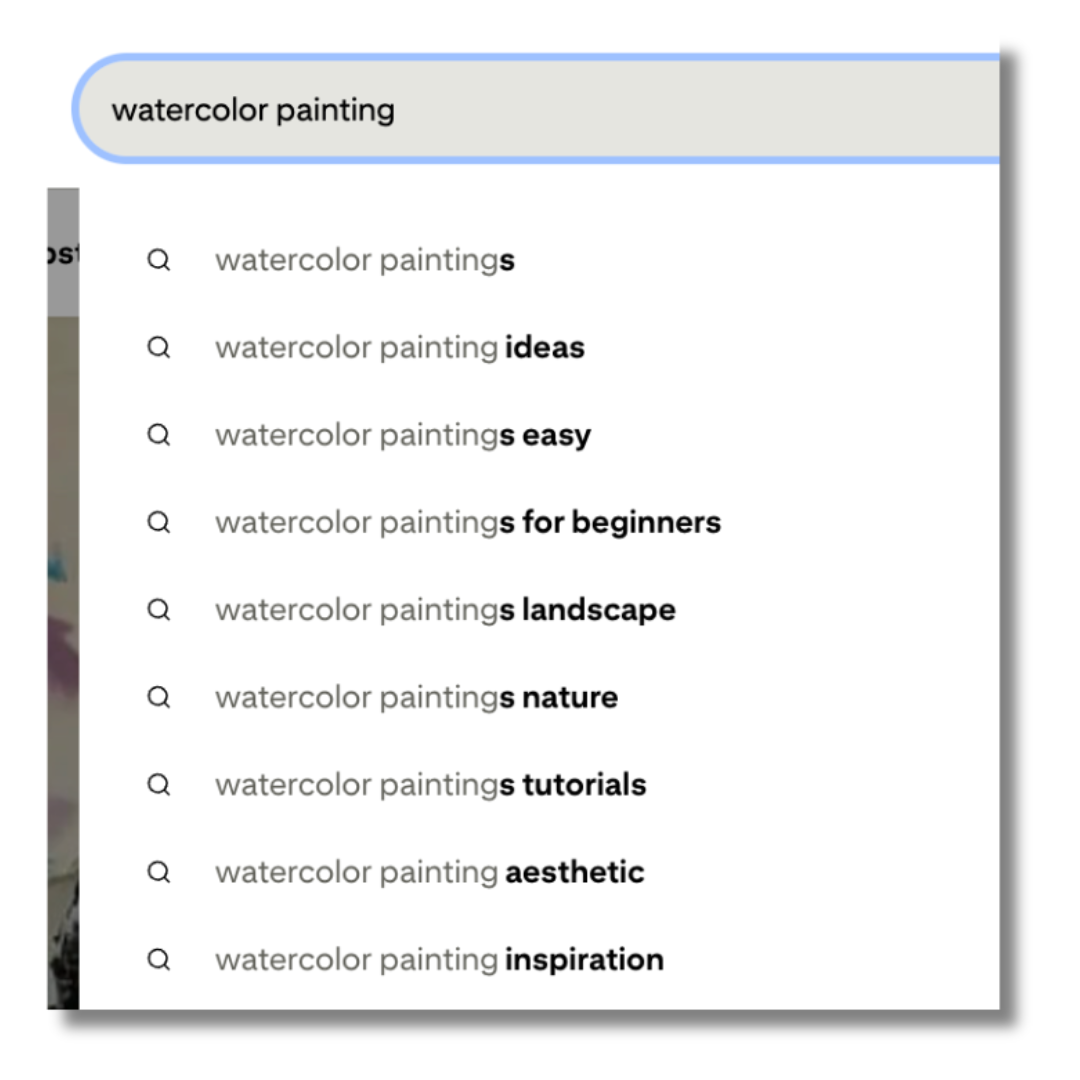
Type a broad phrase into Pinterest’s search bar and watch the autocomplete suggestions appear. These are real searches made by real people. For “watercolor painting” you might see:
- watercolor paintings
- watercolor painting ideas
- watercolor painting aesthetic
- watercolor painting inspiration
Each of these is a keyword opportunity, especially the ones that appear first are generally searched more often.
Keyword Search Bar
Method 2: Guided Search Bubbles
After you run a search on Pinterest, colored bubbles appear below the search bar, these are Pinterest’s guided search categories. They show you how Pinterest categorizes related content and what sub-topics are popular within your search.
Click each bubble to see more specific keyword combinations.
Method 3: Competitor Board Names
Look at well-performing accounts in your niche…not to copy…but to observe which board names and Pin titles they use. If multiple successful accounts use the same phrase, then it’s likely that keyword is worth using.
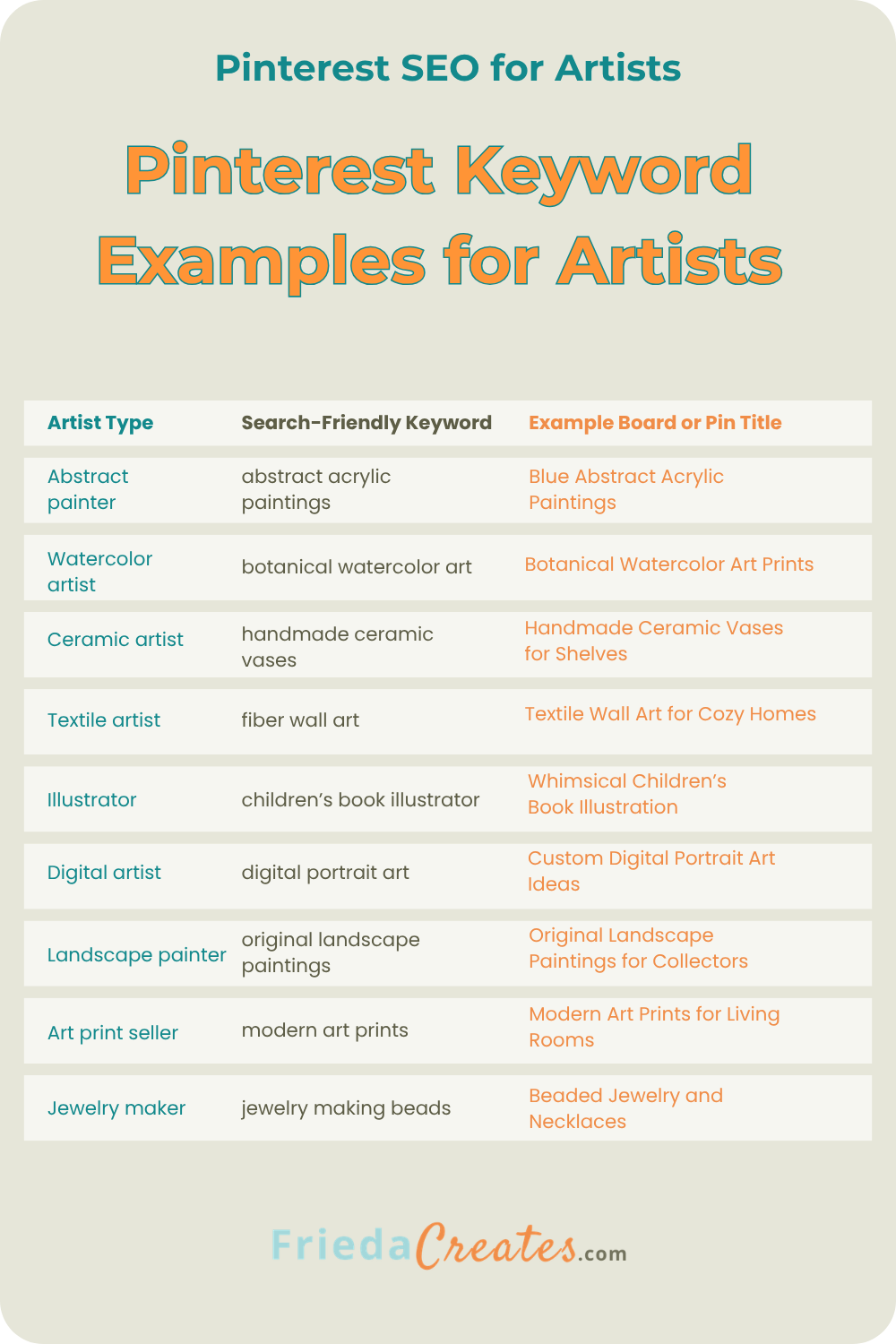
Here’s how strong keyword choices look across different art mediums:
Pinterest Keyword Examples, Pin or Save
Common Pinterest SEO Mistakes Artists Make
Mistake 1: Using vague board names
“Art,” “My Paintings,” “Inspiration”: these words do not inform Pinterest. Rename them to what someone would actually search for.
Mistake 2: Leaving the Pin title blank
Pinterest will auto-generate a title from your description if you leave it blank, but it won’t be as effective as one you write intentionally. Always fill in the Pin title field.
Mistake 3: Writing descriptions for the algorithm, not for people
Pasting a list of keywords separated by dots or commas is not a description. Pinterest reads for meaning and context, not just keyword matches. Write natural sentences to avoid being spammy.
Mistake 4: Pinning to irrelevant boards
A watercolor painting pinned to a board called “Marketing Tips” sends confusing signals. Pin each piece to the most specifically relevant board first, then to broader boards second.
Mistake 5: Inconsistent posting
Pinterest rewards consistency. An account that pins regularly, even just once a day, will outperform one that pins 30 times in a week then goes quiet. Trust me on this one, I’ve gone months between Pinning and have suffered the consequences. Steady and consistent is the strategy.
Mistake 6: Neglecting the destination page
A perfectly optimized Pin that links to a slow, thin, or broken page loses its value the moment someone clicks. Your website is a vital part of your Pinterest SEO. Pinterest and your website can work together, in step, like seasoned dance partners. For a complete look at how to connect your Pinterest presence to real website traffic and sales, read: How to Sell Art on Pinterest: A Practical Guide for Artists.
Pinterest SEO for Your Art Portfolio
If you sell your work, your product pages are some of your most important Pinterest destinations. Each painting deserves its own Pin, and that Pin should link directly to the product page, not to a general shop or homepage. The full path from Pin to sale is explained in detail in How to Sell Art on Pinterest.
Here’s why: when someone saves a Pin of a painting they love, they may come back to that Pin weeks later to buy. If the Pin links to your homepage and they can’t immediately find that specific painting, you’ve lost the sale. And since Pinterest is a slow burn, the most reliable way to stay in front of a buyer between that first save and the sale is your email list. Here’s how to grow an email list with Pinterest.
For each product Pin:
- Use the painting’s title in the Pin title
- Include medium, dimensions, and a price signal (“available,” “original painting for sale”)
- Write a description that tells the story of the piece, what inspired it, what it evokes, and where it might live in a home
- Link directly to the individual product page
- Pin first to your most relevant art board, then save to a secondary board
I returned to painting after years away from the canvas. When I started pinning my new work, I treated every painting the same way I treat every client’s Pin, with intentional keywords, a real story, and a clear path back to the work. Pinterest SEO isn’t just what I teach. It’s what I use. You can see the results in my portfolio.
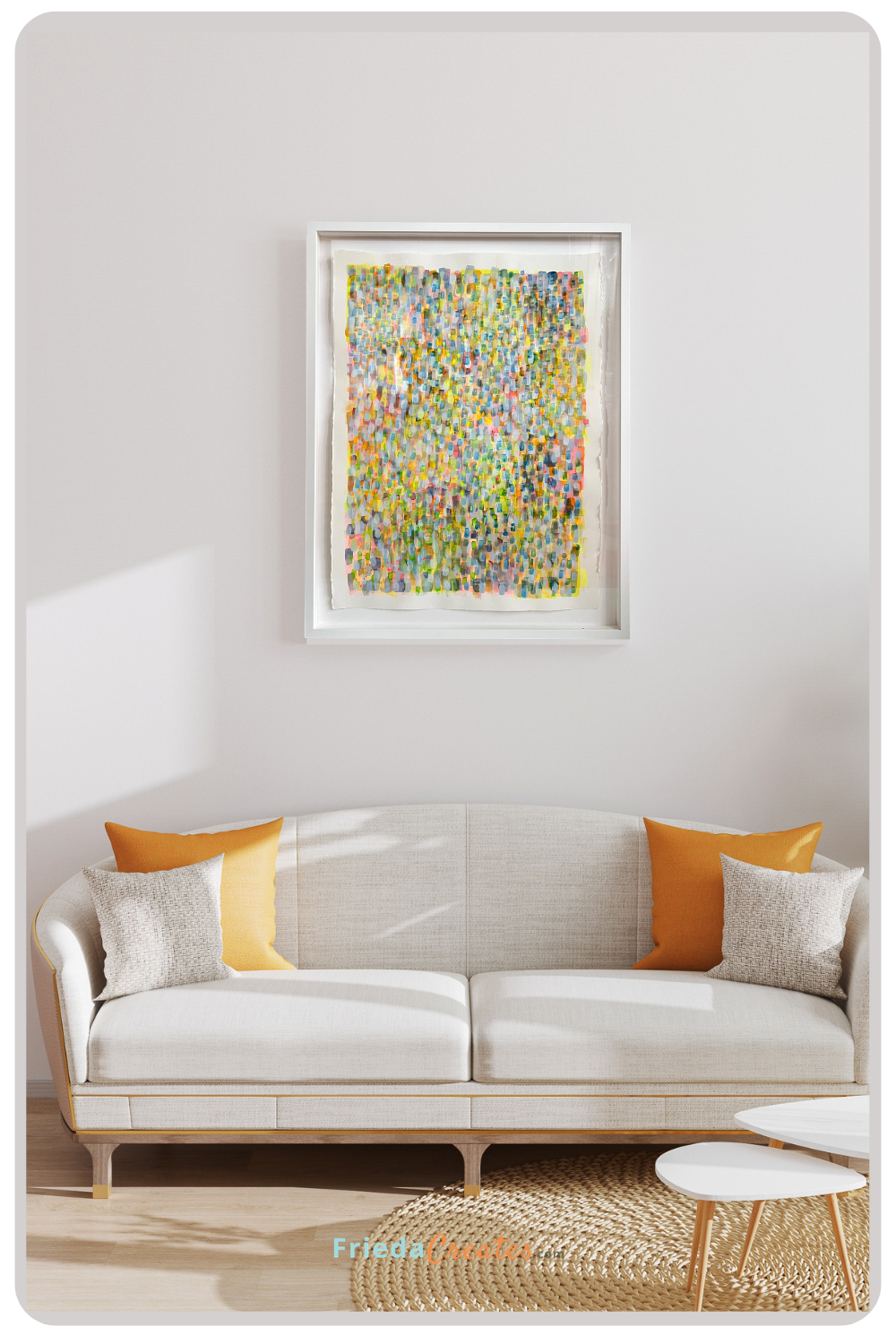
Taking Up Space, Large Original Watercolor Painting
The Pinterest SEO Timeline: What to Expect
This is the question I hear most from artists starting out: how long does Pinterest SEO take to work?
The honest answer is three to six months before you see consistent, meaningful traffic. Pinterest indexes new Pins, evaluates engagement signals, and distributes content gradually. Unlike Google, where a well-optimized page can rank within weeks, Pinterest builds momentum slowly, and then compounds.
Timeline for a Pin, particularly on a new account:
- Month 1-2: Pins are indexed, initial distribution begins, very little visible traffic
- Month 3-4: Consistent pinning starts to build pattern recognition in the algorithm
- Month 5-6: Pins begin ranking in search, traffic starts appearing in analytics
- Month 6+: Compound growth begins, older Pins continue performing while new ones build
The artists who give up at month two may never see month six. Consistency in the early months is the entire game.
When to DIY Pinterest SEO, and When to Get Help
Pinterest SEO is something many artists can learn, especially if you enjoy organizing your work and writing descriptions. If you want to understand the full system, boards, keywords, Pin creation, and analytics, the Pinterest Primer course was built for exactly that. Self-paced, artist-specific, and designed to make Pinterest feel manageable rather than overwhelming.
If you’d rather stay in the studio and have someone handle Pinterest for you, Pinterest account management for artists covers strategy, Pin design, keyword research, scheduling, and monthly reporting.
The right choice depends on your time, energy, and goals. Both paths lead to the same place, a Pinterest presence that works while you create.
Where to Go From Here
Pinterest SEO is a skill, and like any skill, it builds with practice and feedback.
If you want to learn the full system, from profile setup through boards, keywords, Pin creation, and analytics, the Pinterest Primer course is where I’ve put everything I know into a self-paced course built specifically for artists and beginners.
If you’d rather have someone look at what you already have and tell you exactly what to fix first, a Pinterest Account Audit gives you a clear action plan without the guesswork.
And if you’re just getting started, the Board Starter Guide is free and will walk you through the foundation, your boards, before anything else.
Pinterest SEO is patient work. But it’s the kind of work that keeps working long after you’ve set down your brushes for the day. Ready to put your Pinterest SEO to work? Read the complete strategy guide: How to Sell Art on Pinterest
Frequently Asked Questions
1-Is Pinterest SEO worth it for artists? Yes. Pinterest SEO can help artists make their work easier to discover by people searching for specific styles, mediums, decor ideas, gifts, tutorials, or artwork. It works best when your Pins, boards, and website pages are clearly connected.
2-How do I find the right keywords for my art on Pinterest? Start by typing broad phrases related to your work into Pinterest’s search bar and noting the autocomplete suggestions. These are real searches. Also look at the guided search bubbles that appear after a search, they show you how Pinterest categorizes related content.
3-How long does Pinterest SEO take to work for artists? Typically three to six months of consistent pinning before you see meaningful, regular traffic. Pinterest builds momentum slowly and compounds over time. The artists who stay consistent past month three see the biggest results.
4-Where should I put keywords on Pinterest? In six places: your profile name and bio, your board titles, your board descriptions, your Pin titles, and your Pin descriptions. Consistency across all six locations signals to Pinterest what your account and content are about.
More Questions About Pinterest SEO for Artists
5-Do I need a big following for Pinterest SEO to work? No. Pinterest distributes content based on search relevance and engagement signals, not follower count. A well-optimized Pin from a small account can outperform an unoptimized Pin from a large one.
6-How many boards should I have as an artist on Pinterest? Start with 5-8 well-named, focused boards rather than dozens of vague ones. Quality and specificity matter more than quantity. Each board should have a searchable name, a keyword-rich description, and consistent, relevant content.
7-Should I pin my own art or other people’s content? Both. A healthy Pinterest account pins a mix of your own work and curated content relevant to your niche. A rough guide: 60-70% your own content, 30-40% curated content.
8-Should every Pin link to my homepage? No. Most Pins should link to the most relevant web page; a painting Pin links to the product page, a teaching Pin links to the blog post, a course Pin links to the course page, etc. Specific links help visitors take the next step and help Pinterest understand what the Pin is about.
9-What is the biggest Pinterest SEO mistake artists make? Being too vague. Vague board names, vague Pin titles, and vague links make it harder for Pinterest to understand your art, and harder for viewers to know what to do next.