Short answer: To grow a Pinterest email list as an artist, give people a reason to subscribe (such as a small, useful free download called a lead magnet, which has worked well for me). Then use keyword-rich Pins to send the right people to a page on your website where they can sign up. Pinterest is where you and your work are discovered; your email list turns those web visitors into buyers and collectors. You actually own this list; you build and nurture a relationship with them, rather than renting space on a platform that can change overnight.
Disclosure: This post includes a couple of affiliate links, marked with an asterisk (*). If you sign up through one, I may earn a small commission at no extra cost to you. I only recommend tools I actually use and love.
Pinterest is where people go to plan, dream, and decide, including deciding whose art to follow, save, and eventually buy. But many artists miss this nuance: a save on Pinterest is a maybe. An email address is a relationship.
If you’ve been pouring energy into Pinterest without a way to keep the people it sends you, this guide is your next step. A Pinterest email list for artists puts you back in control; it’s how you stop starting from zero every time the algorithm shifts, and instead, begin building an audience of collectors who want to hear from you personally.
Let’s build yours, one step at a time.
Come back to Pin me after you read. ⤵️
Why an email list matters more than followers
Followers and impressions belong to Pinterest. Your email list belongs to you. That distinction empowers a working artist by putting you in the driver’s seat.
Think of it as the difference between renting and owning. Pinterest traffic is rented, which is lovely, but not fully in your control. An email list is owned. When you release a new collection, open commissions, or drop prints, you’re not hoping the feed is perfectly distributing your Pins. Having an email list, your news and messages are delivered directly to the inboxes of people who already raised their hand and said, “I want to hear from you.”
For artists specifically, an email list does three powerful things:
- It warms up buyers. Someone rarely buys a painting the first time they see it. Email gives you the repeated, low-pressure touchpoints that turn an admirer into a collector.
- It protects your income. Platforms rise and fall. A list you’ve nurtured is the one audience no algorithm can take away.
- It fits an introvert’s pace. You don’t have to perform daily. A thoughtful note once or twice a month keeps the relationship alive.
Why Pinterest is a natural fit for growing an artist email list
Most social platforms are built to keep people scrolling. Pinterest is built to help people go somewhere because it’s a visual search engine. People on Pinterest (Pinners) arrive already looking for ideas, inspiration, and things to buy. That intent is exactly what makes it such fertile ground for growing your list.
When someone searches “small living room art” or “abstract watercolor prints,” they’re in planning mode. If your Pin meets that moment and offers something genuinely helpful, the leap from “save this” to “give me your email for the full guide” is short and natural.
Pinterest also rewards evergreen content. A Pin you make today can keep sending subscribers your way for months, even years, unlike a social post that disappears by tomorrow. That’s steady, compounding growth, which is an ideal fit for your art business.
The simple system: how Pinterest feeds your email list
Before I share the steps in detail, here are the stages of the marketing funnel, so you can see what to do at each.
A marketing funnel for artists:
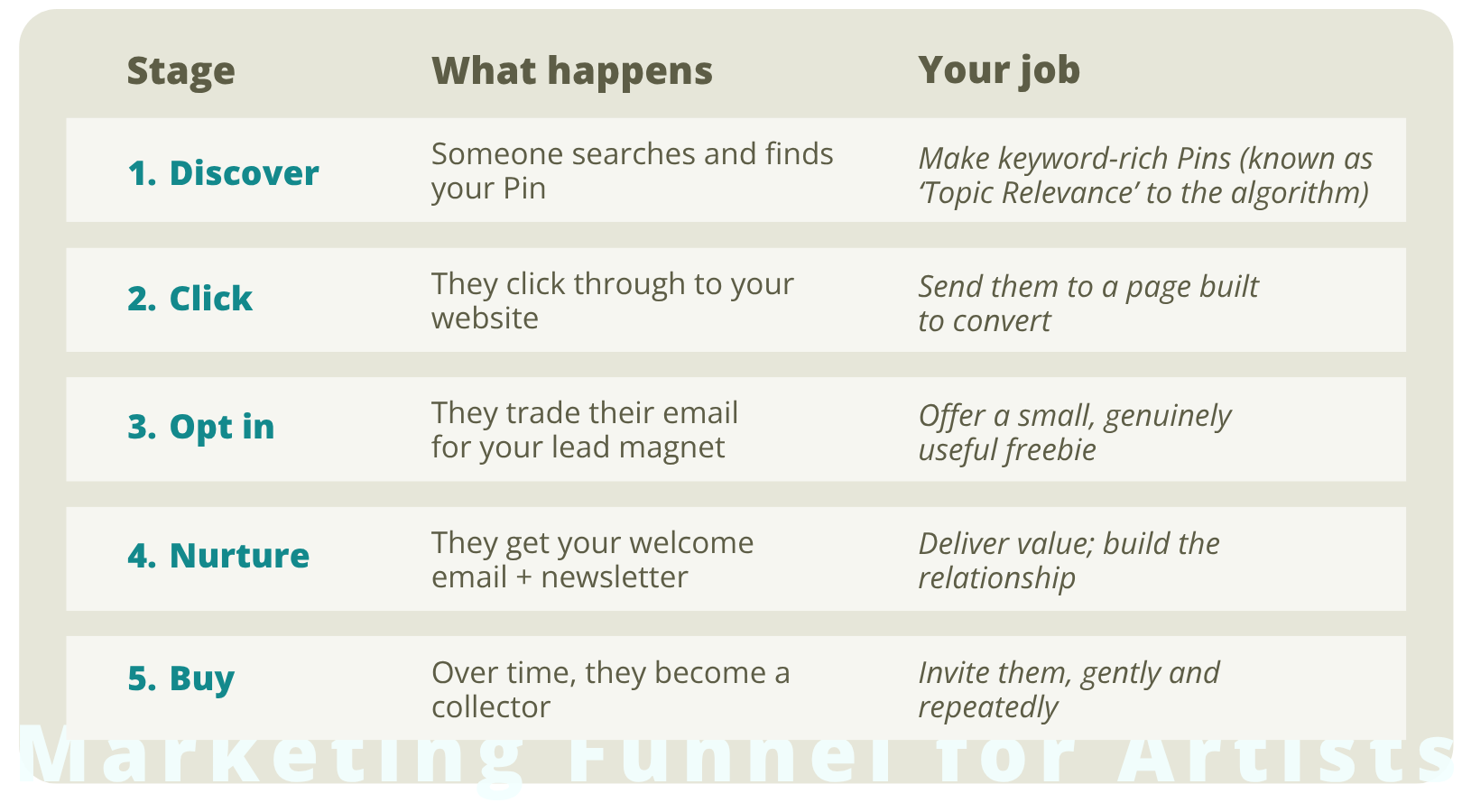
Five steps to building an artist marketing funnel
Step 1 — Create a Pinterest lead magnet artists actually want
A lead magnet is the small free thing someone receives in exchange for giving you their email. It doesn’t need to be elaborate. It needs to be useful and specific, like solving one real problem for the exact person you’d love to sign up on your list.
The mindset shift that matters most: your lead magnet should attract buyers and collectors, not just other artists looking for freebies. So tie it to the world around your art, not only to your technique.
Lead magnet ideas by artist type:
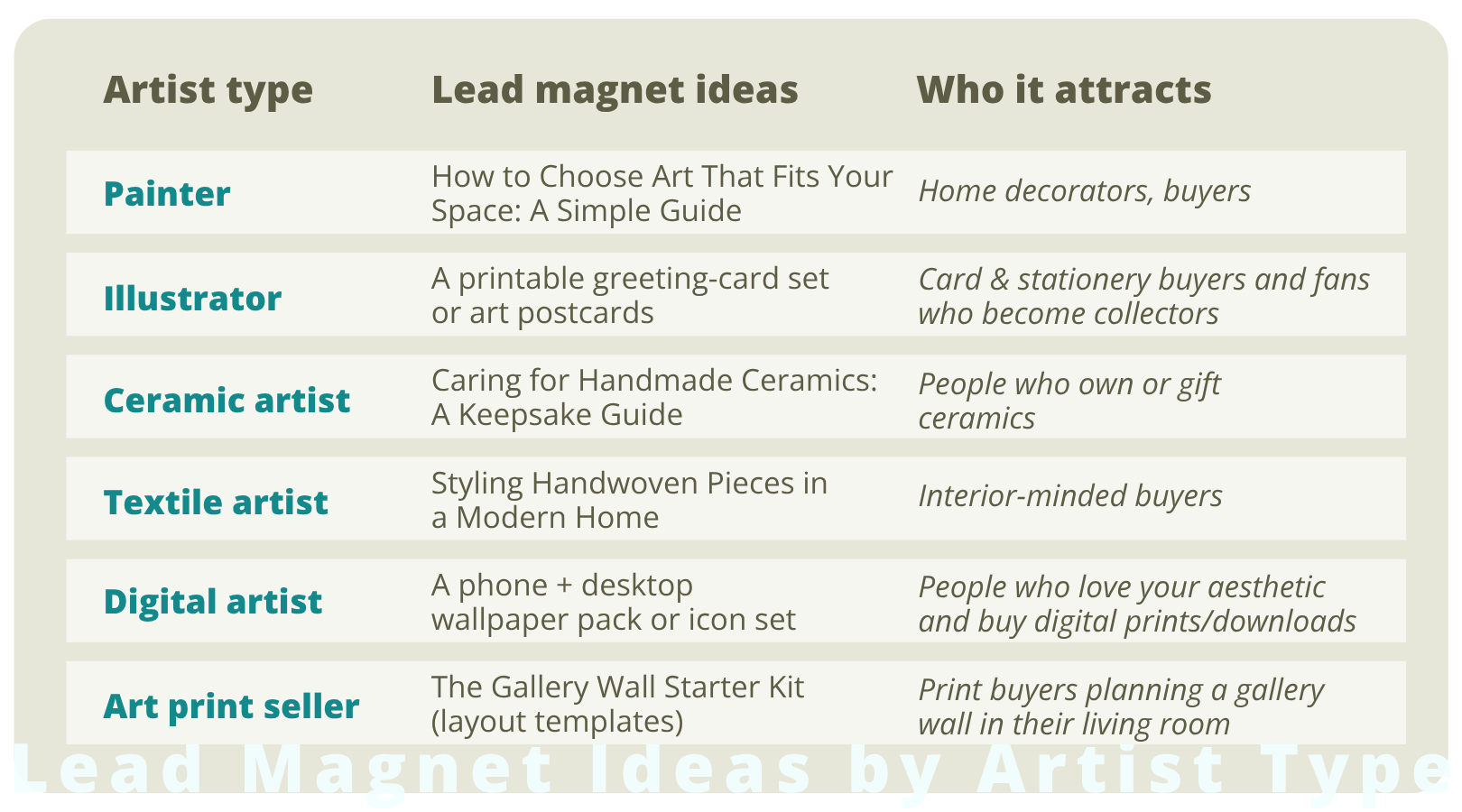
Notice the pattern: each freebie is tailored to the art. It attracts the person who’d eventually buy, not just the admirer.
If your goal is more of a teaching audience (other artists), your lead magnet can be craft-focused. Consider making a color-mixing cheat sheet, a sketchbook prompt pack, a studio checklist. Both are valid; just be intentional about whom you’re inviting in.
My own free guides, like the Board Starter Guide, are lead magnets built for the artist, like you. See more lead magnets on the Resources page.
Step 2 — Build a simple signup form on your own website
This is where Domain Quality (a key factor of the Pinterest algorithm) comes into the picture. Pinterest decides how far to send your Pins based, in part, on how much it trusts the website they lead to. So your email signup shouldn’t live on a random third-party link, it should live on your claimed, trustworthy website. The stronger your site, the more Pinterest is willing to send people to it, and the more of those visitors you can convert.
To set this up:
- Use an email platform to create a simple signup form. (I use and recommend MailerLite*; it’s intuitive and beginner-friendly.)
- Keep it frictionless. For a lead-magnet form, single opt-in (no extra “confirm your email” step) usually converts best, the freebie arrives instantly, and the person isn’t left waiting or confused.
- Deliver the freebie by email with a short, warm welcome, so their very first impression of you is generous.
- Give the form a real home — a dedicated page or a spot inside a relevant blog post, so your Pins have somewhere specific to land.
A signup box buried in a footer won’t grow a list. A clear, single-purpose page will.
Step 3 — Make Pins that lead people to your list
Now connect the traffic to the offer. A list-building Pin is just a Pin whose destination is your signup page instead of a product or blog post.
Three things make these Pins work:
- A keyword-rich title. Write the words people actually search. If you’re not sure how to do this, hop over to how to use keywords on Pinterest; it’s the same skill that ranks your art and ranks your freebie.
- A clear, benefit-first text overlay. For example: “Free guide: Choose art for your space” beats “Sign up for my newsletter.” Lead with what they get.
- A destination that matches the promise. If the Pin promises a gallery-wall kit, the page it opens should deliver exactly that. Please, no bait and switch. Matching the click to the promise builds trust with both the visitor and Pinterest.
Make several different Pins for the same freebie over time. Fresh Pins are what Pinterest distributes most, so one lead magnet can be promoted using different Pins throughout the year.
A quick note on the bigger picture: getting found, sending people to a site Pinterest trusts, and converting them into subscribers are all part of the same foundation. If you want the full walkthrough of setting that foundation up, i.e. setting up your business account, claiming your site, searching for the best keywords, and creating findable boards, well, that’s exactly what I teach inside the Pinterest Primer course. I made this course for the beginner, a stress-free start-to-finish path for artists who’d rather learn it once and do it right.
Step 4 — Use your profile and boards to grow your email list, too
Your Pins do the heavy lifting, but these two often-forgotten spots will keep the signups consistent:
- Your Pinterest bio + website field. Add your site so every profile visitor has a one-tap path to your world (and your freebie). If your homepage or a linked page features your signup, you’re capturing interest you’d otherwise lose.
- A “Free Resources for Artists” board (or similar, named for search). A board that collects your freebie Pins gives people a browsable home for your lead magnets while simultaneously reinforcing the topic to Pinterest. For help naming boards so they get found, see how to name your Pinterest boards.
Step 5 — Nurture new subscribers so they become collectors
Getting the email is the beginning, not the finish line. What you send next decides whether someone becomes a buyer or a forgotten name on a list.
Start with a welcome email that delivers the freebie and sets the tone: warm, human, and inviting. Then keep showing up with an artist newsletter that people actually want to open.
Artist newsletter ideas that build connection (and sales):
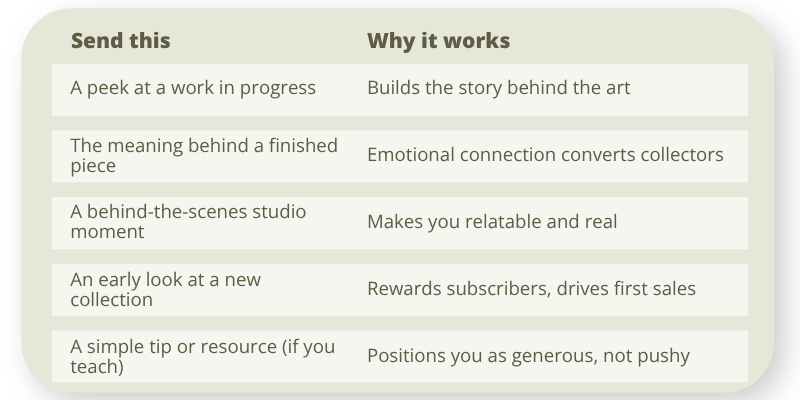
You don’t need to sell in every email you send. In fact, you shouldn’t. Give more than you ask, and when you do invite people to buy or commission, they’re more open and ready.
Common mistakes that stall list growth
- No lead magnet. “Sign up for my newsletter” rarely converts on its own. Give a specific reason.
- Sending Pins to a homepage. A general page confuses the visitor. Send them to one clear offer.
- Over-complicating the tech. One form, one freebie, one welcome email is enough to start. You can refine later.
- Attracting the wrong crowd. If every freebie targets other artists but you sell paintings, you’ll grow a list that admires but doesn’t buy. Match the magnet to the collector.
- Going silent. A list you never email goes cold. Even once a month keeps the relationship warm.
The Domain Quality connection
This is how the pieces connect. Pinterest is a search engine that sends people to websites. It sends more people to websites it trusts; the Pinterest algorithm calls this Domain Quality. Your email list is what you build once those people arrive: the owned audience that outlasts any single platform.
So the work compounds. A claimed, trustworthy site earns more Pinterest traffic; a clear lead magnet converts that traffic into subscribers; a warm newsletter turns subscribers into collectors. Each piece strengthens the next. (If you want to go deeper on selling through this system, read how to sell art on Pinterest, and for the discovery side, Pinterest SEO for artists.)
You don’t have to build all of it this week. Start with one lead magnet and one signup page. That single step turns your Pinterest traffic from visitors passing through into an audience you get to keep.
Want your Pinterest to grow your list while you focus on making art? If setting all this up feels like one more thing on a full plate, I can do it for you. Explore my Pinterest management services. I’ll build the system that turns your Pins into subscribers and buyers, so you can get back to the studio.
FAQ
Yes, arguably more than you need followers. Social platforms rent you an audience; an email list is one you own. It’s the most reliable way to warm up buyers, announce new work, and protect your income from algorithm changes.
A lead magnet is the free, specific thing someone receives in exchange for subscribing (a guide, printable, or wallpaper pack). The newsletter is what you send afterward to nurture the relationship. The lead magnet gets them in the door; the newsletter keeps them.
Something small, useful, and matched to your buyer — not just other artists. A painter might offer “How to Choose Art for Your Space”; a ceramic artist, a care guide. Tie the freebie to the world around your art so it attracts future collectors.
To a clear page on your own website built around one offer — a dedicated landing page or a relevant blog post with a signup form. Avoid sending list-building Pins to a general homepage; the more specific the page, the better it converts.
For lead magnets, single opt-in usually works best — the freebie arrives instantly with no extra confirmation step. Save double opt-in (which adds a “confirm your email” step) for spam-sensitive forms like a general newsletter signup.
Consistency matters more than frequency. Once or twice a month is plenty for most artists. The goal is to stay a welcome, familiar presence — not to flood inboxes.
Any beginner-friendly platform works. I use and recommend MailerLite for its intuitive setup, but the best tool is the one you’ll actually use. Start simple: one form, one freebie, one welcome email.
Pinterest rewards evergreen content, so growth tends to be gradual and compounding rather than instant. Fresh, keyword-rich Pins pointing to a strong signup page will build your list steadily over weeks and months.