Wondering what ‘Pinterest marketing for artists’ means? It means using Pinterest as a visual search engine, not a social feed, to help people find your creative work while they’re actively searching for art (such as an art lover wanting to purchase or a collector). You create Pins that link back to your website, organize them into keyword-focused boards, and let each Pin keep working for months. Done well, it turns intentional browsing into website visits, email signups, and sales.
Much of Pinterest advice is written for food bloggers or home decorators. You’ve probably noticed the tips about easy chicken recipes and affiliate funnels that don’t quite align with a person who makes things. So let’s begin with what’s real: Pinterest is one of the best-kept secrets in the art world, and almost none of the popular advice is written for you.
But this guide IS written for you.
Whether you paint, illustrate, throw pots, weave, work digitally, or sell prints, here’s how Pinterest marketing actually works for artists, at an easy-to-follow pace. Or come back here when you need a refresher.
Pinterest isn’t social media (and that’s good news for artists)
Here’s the distinction that makes it all click into place: Pinterest is a search engine, not a social network.
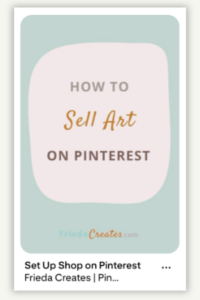
On Instagram, your post is loudest the day you publish it, then fades. On Pinterest, a Pin you make today can surface in someone’s search months, sometimes years, from now. In fact, I created this Pin back in 2022, oh gosh, and it is still surfacing in Pinterest search today; it’s proof of how long a single Pin can keep working.
People don’t come to Pinterest to catch up with friends. They come with intent: to plan a room, find a gift, decorate a wall, discover an artist. That mindset is gold for anyone selling creative work.
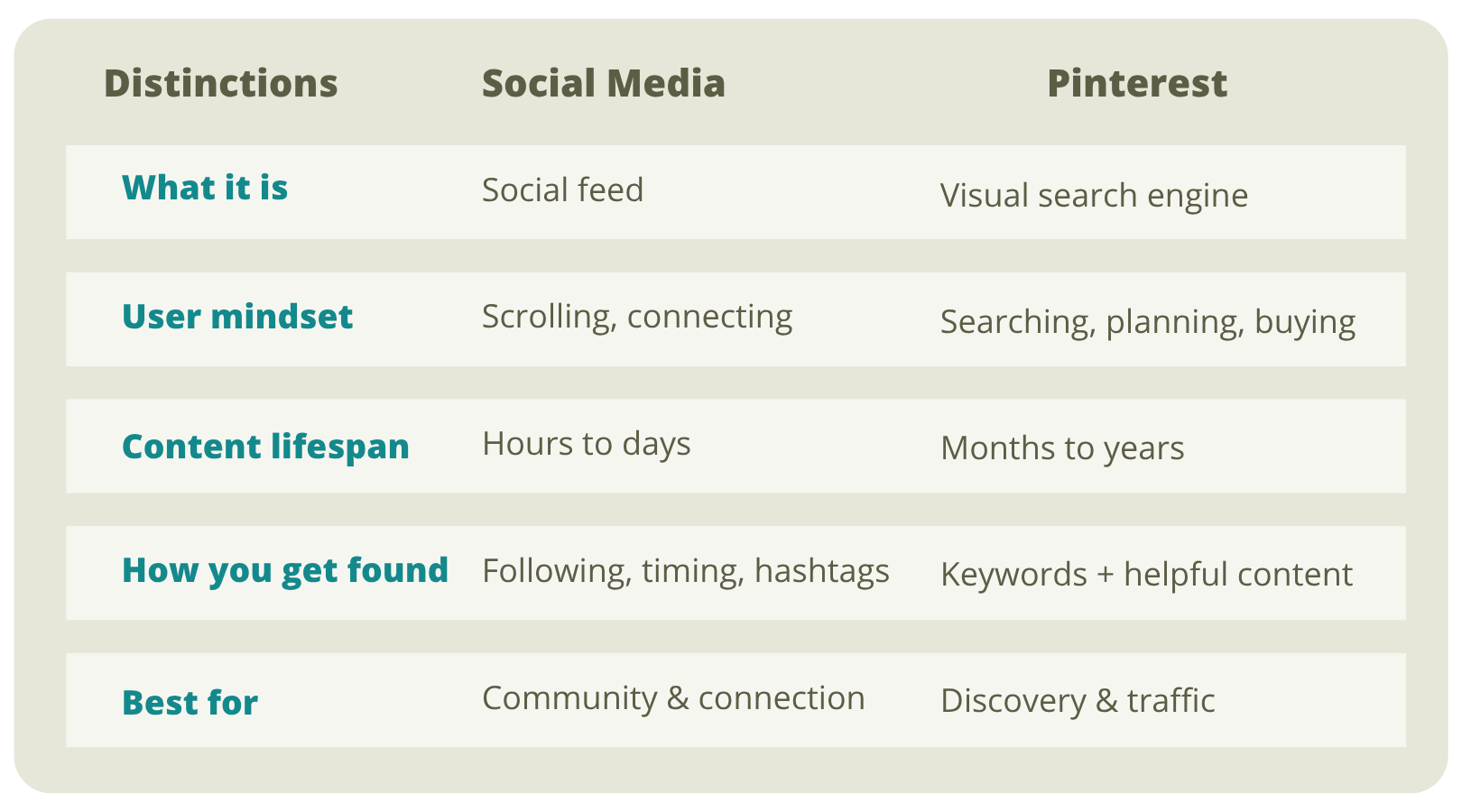
You don’t have to choose one over the other. But the two platforms are different, and Pinterest rewards the artist who understands how to use it as a search tool.
The Foundation: a Pinterest Business Account
Before any of this works, you need a free Pinterest business account (not a personal one). A business account unlocks analytics, lets you claim your website, and makes your Pins eligible for richer search placement.
If you’re starting from zero, I walk through the exact set up for your profile, how to claim your website (and its meaning), and building your first boards. For the complete guide, Pinterest SEO Starts With These 7 Steps. Get this foundation right once, and everything after flows so much better.
Step 1 — Think in keywords, not hashtags
Because Pinterest is a search engine, it needs to understand your work in words. That’s Pinterest SEO at work, and it’s less technical than it sounds. You’re simply describing your art the way a searcher would type it in Pinterest’s search bar.
A painter might reach for “abstract landscape painting.” A buyer searching Pinterest might type “colorful abstract wall art for living room.” Same painting, but very different words. Your job is to meet the searcher where they’re at, using their language, not how you might describe it in your studio.
Put those phrases where Pinterest reads them: your profile, your board names, your board descriptions, and every Pin title and description. If you want the deeper version, my post on Pinterest SEO for artists breaks it down step by step. Plus, my free Keyword Kit can get you started faster.
Step 2 — Build boards that match how people search
Think of your boards as the aisles of a shop. Each one should be about a single, searchable topic — not a vague mood.
Avoid general labels: “My Work,” “Inspo,” “Pretty Things“
Descriptive is better: “Original Watercolor Paintings,” “Abstract Art for Home Decor,” “Handmade Ceramic Mugs“
Clear boards help Pinterest file your work correctly, and they help buyers find the exact thing they’re picturing. If naming boards makes you freeze, my board naming guide for artists gives you a simple system.
Step 3 — Make Pins that get found and clicked
A Pin has two jobs: get discovered in search, then earn the click. That means two different pieces of text working together.
- The Pin title carries your keywords (for search).
- The text overlay on the image is the hook (for the human scrolling). Keep it short — a few words that promise something.
And design for the thumbnail, because that’s how nearly everyone first sees your Pin — small, on a phone, in a busy grid. Build tall (1000 x 1500 pixels), keep one clear focal point, and make sure any text is legible when the image is shrunk to the size of a stamp. A gorgeous Pin that’s unreadable at thumbnail size is a Pin nobody opens.
Step 4 — Be sure every Pin connects to live, high-quality pages
Every Pin is a doorway, and it should open onto your website leading to a product page, a portfolio piece, a blog post, or feature page. Pinterest can send you the most engaged visitors you’ll ever see, but they’ll only stay if there’s a place worth landing. And one of the most valuable places to land them is an email signup; capture a visitor once, and you can reach them again long after they leave. Here’s how to grow an email list with Pinterest.
Unfortunately, a lot of artists lose the sale when overlooking this important step. The Pin may be beautiful, so the click happens, but the page it lands on is thin (doesn’t have well-thought-out content), loads slowly, or is missing a clear call to action. Make the destination as considered and enriching as the Pin.
✨ Ready to stop piecing it together?
If you’d rather follow one clear path instead of assembling tips from all over, that’s exactly why I built Pinterest Primer — my step-by-step Pinterest course for artists. It takes you from a quiet account to a system that works, without the overwhelm.
Pinterest marketing looks a little different for each kind of artist
The principles are the same; the emphasis shifts with your medium. Here’s where I’d point your energy:
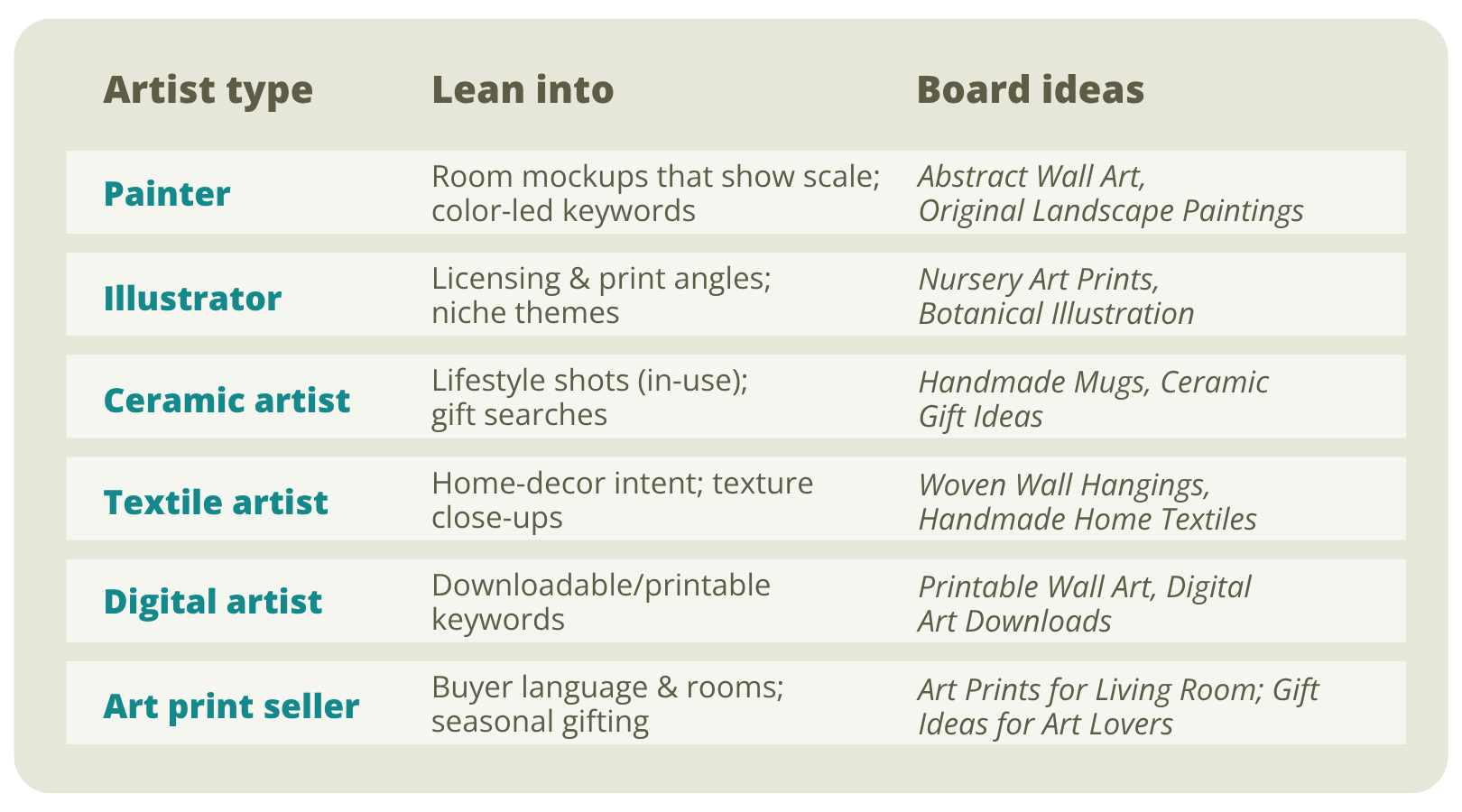
Notice the pattern: every board speaks the buyer’s language, not the studio’s. “Woven wall hanging” gets found; “my fiber experiments” does not.
The mistakes I see most often
Treating Pinterest like Instagram — posting once and expecting instant reach. Pinterest is patient; so are its rewards.
Vague boards and titles — if Pinterest can’t tell what a Pin is about, it can’t show it to the right person.
Sending Pins to a weak page — the click is only half the win.
Quitting at week three — Pinterest builds slowly, then compounds. Consistency beats intensity.
How long until it works?
Honestly? Longer than a social post, and worth more. Pinterest tends to be quiet for the first weeks while it learns what your account is about, then builds as your Pins get indexed and start ranking. Think of it less like a firework and more like planting — the work you do this month keeps returning for many months after. If you sell seasonal or evergreen work, that long tail is a genuine advantage.
If you’d like the bigger-picture version of why Pinterest still drives real traffic for artists, I wrote about it in how artists can use Pinterest marketing to drive website traffic. And when you’re ready to sell in earnest, how to sell art on Pinterest picks up where this guide leaves off.
New here altogether? Start here with Pinterest marketing for artists is the front door to everything.
Would you rather someone did this for you?
Building a Pinterest presence takes time — time you might rather spend in the studio. If you’d like an experienced set of hands on your account, take a look at my Pinterest management and audit services. I help artists turn Pinterest into a quiet, steady source of discovery and traffic, so you can get back to making the work.
Pin to your Pinterest for Artists board to come back to 👇
FAQ
Yes — arguably better for artists than most platforms, because Pinterest users are actively searching for art, gifts, and home decor with buying intent, and your Pins keep getting found for months rather than disappearing in a day.
Yes. A free Pinterest business account unlocks analytics, lets you claim your website, and makes your work eligible for richer search placement — all essential for marketing.
Instagram is a social feed built on timing and community; Pinterest is a search engine built on keywords and discovery. A Pin can surface in search months after you make it, which makes Pinterest better for steady, long-term traffic.
Consistency matters more than volume. A small, steady rhythm you can sustain beats an occasional burst. Start with what you can maintain and grow slowly as it becomes routine.
Yes — but Pinterest usually sells indirectly. It drives the right people to your website, where the sale happens. Make sure every Pin links to a strong product or portfolio page.
Expect a quiet start while Pinterest learns your account, then gradual growth as your Pins get indexed and ranked. It rewards patience and consistency more than intensity.
No — keywords do. Focus your energy on clear, searchable words in your titles, descriptions, and board names rather than hashtags.
Set up a business account, claim your website, and create a few keyword-clear boards. From there, add Pins that link back to your best pages.