
What is Pinterest board SEO? Pinterest board SEO* is the practice of naming, describing, and organizing your boards with the words people actually search, so Pinterest understands what you create and shows your art to the right people. For artists, your boards aren’t just folders, they’re signals telling the Pinterest algorithm what topic your board is about. A board called “Original Watercolor Botanicals for Sale” gets found; a board called “My Art” gets lost because it’s way to broad a subject.
Most artists set up their Pinterest boards once, name them something that makes sense to them, and seldom, if ever, think about it again, such as: “My Work.” “Inspiration.” “Stuff I Love.” It’s no wonder why their beautiful paintings aren’t getting discovered.
On Pinterest, your boards are doing SEO whether you’ve optimized them or not. They’re either telling Pinterest exactly who your art is for, or telling it nothing at all.
The good news? Fixing this is one of the highest-leverage, lowest-effort things you can do on Pinterest. You don’t need to make a single new Pin. You just need to help Pinterest understand the ones you already have.
Let’s walk through it.
Why Pinterest board SEO matters for artists
Pinterest isn’t a social feed, it’s a visual search engine. People come to it the way they come to Google: searching for something specific, for example, an interior designer may look for “Abstract wall art for living room” or “Botanical watercolor prints.” A collector may be searching for “Handmade ceramic vases.”
To answer those searches, Pinterest has to understand what each Pin is about and where it belongs. That’s where boards come in. Pinterest reads your board names, board descriptions, and the Pins inside each board as signals, they are a part of an internal map the algorithm uses to connect what you make with who’s looking for it. (If you’ve heard the term Taste Graph* that’s the behind-the-scenes system doing this matching.)
So a Pin of your painting saved to a board called “Abstract Acrylic Paintings for Modern Homes” lands in a very different place than the same Pin saved to “My Stuff.” Same art. The likelihood of each Pin’s discoverability is completely different.
This is also why board SEO is more important in 2026, and moving into 2027, than it used to be. Pinterest now leans heavily on intent and context, it rewards accounts that are clearly, consistently about something. Singularly focused, well-named boards with researched keywords are how you send that signal. For the bigger picture of how keywords work across your whole account, start with Pinterest SEO for Artists.
The problem with vague boards (the “My Art” trap)
A board named “My Art” asks Pinterest to guess. And Pinterest doesn’t guess, rather, it ignores your Pins and they don’t get ranked.
Vague board names fail for three reasons:
- No one searches them. Nobody types “my art” or “inspiration” into Pinterest when they want to buy a painting.
- They mix everything together. A catch-all board of landscapes, portraits, abstracts, and process shots gives Pinterest no clear topic to attach you to.
- They waste your best asset. You made beautiful work but a vague label doesn’t support it.
The fix is to make every board searchable and specific. Here’s how.
How to name your Pinterest boards for SEO (your biggest lever)
Board names are the single most powerful SEO move you can do on Pinterest. The rule is simple: name your board for what a buyer would type into Pinterest search, not for what sounds clever.
A good formula is: artist medium + subject + (where it belongs or who it’s for). Here’s what that looks like across different kinds of artists:
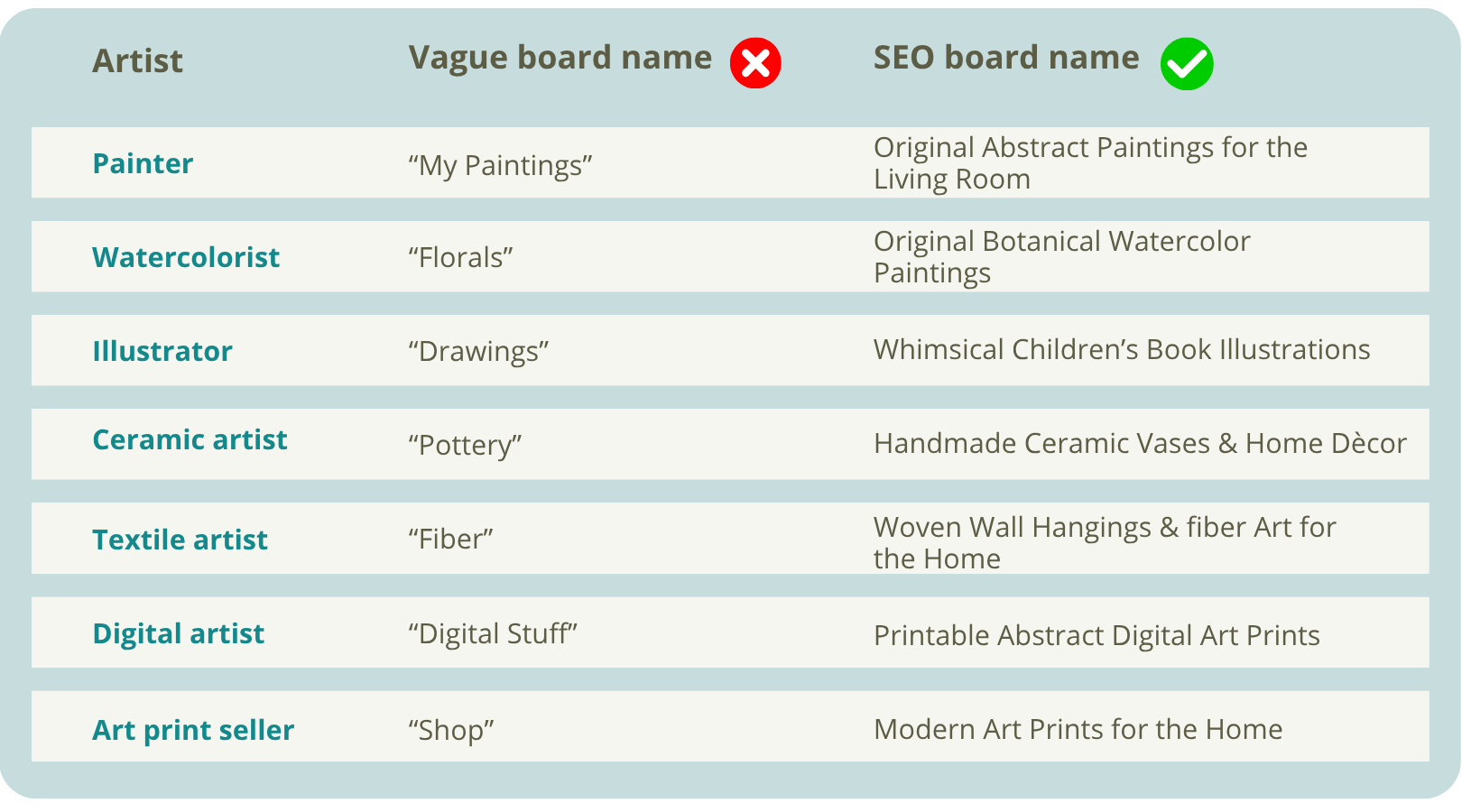
Notice what these names do at a glance: they say the medium (watercolor, ceramic, fiber), the subject or style (botanical, abstract, whimsical), and often who it’s for or where it goes (for the living room, for the home). That’s three search signals in one short line.
Keep board names to 50 characters or fewer which is Pinterest’s limit, and only about the first 21 show before a board is opened, so front-load the important words. (Pinterest fields have limits, for a full rundown see my simple guide to Pinterest character counts).
For a deeper walk-through of naming boards from scratch, The Board Starter Guide has examples for more mediums, and if you need fresh board inspiration, Pinterest board ideas for artists is a good article to browse.
Write board descriptions that actually get found
Often, artists leave board descriptions blank. That’s a missed, free SEO opportunity. The board description is another place Pinterest reads to understand your topic, and you have up to 500 characters there to include more on-topic, relevant keywords to guide the algrorithm.
You don’t need to be clever here. You need to be clear and searchable. Write two or three plain sentences using words someone might actually type, and describe what’s inside and who it’s for.
Here’s a board description example for Botanical Watercolor Paintings:
Original botanical watercolor paintings; flowers, leaves, herbs, and garden blooms painted in soft, layered color. Loose, nature-inspired watercolor botanical art, from delicate florals and wildflowers to statement calla lilies. Each piece is available as an original painting or fine art print for a calm, botanical home. New watercolor flower paintings added often, follow the board and save your favorites.
Notice how that pulls in the exact phrases people actually search, botanical watercolor paintings, watercolor botanical art, watercolor flowers, fine art prints, yet still reads like a human wrote it. Here’s the trick for finding them: type your board’s topic into Pinterest search and borrow the phrases that drop down, plus the “related searches” at the bottom of the results. That’s Pinterest handing you the exact words buyers use and those carry real weight.
Two cautions. Keep it readable, a natural paragraph, never a comma-separated keyword dump. And match the intent of your board: a selling board wants buyer phrases (original, for sale, fine art prints, for the living room), so skip the learner/DIY autocompletes (tutorial, easy, for beginners, step-by-step) those pull hobbyists who want to make art, not collectors who want to buy it. You have up to 500 characters, so use them well. (Need help finding the right phrases? Here’s how to find the right Pinterest keywords, and where to place every keyword.)
Organize your boards for topical authority
When it comes to naming and describing boards we’re looking at individual boards. But organizing your boards is learning how they work together and it’s where artists win or lose when it comes to topical authority which is the clear, consistent signal that makes Pinterest rank you as the source for your niche. Get it right and your whole account compounds…get it muddled and even your strongest pieces stay scattered and hard to find.
One clear topic per board.
Resist the catch-all phrase. A board should be about one searchable thing. If your “Paintings” board holds abstracts, florals, and portraits, split them onto separate boards: Abstract Paintings, Botanical Paintings, Portrait Paintings. Each tightly themed board becomes a stronger signal, plus, Pinterest rewards clearer, more consistent boards with more distribution.
How many boards?
Start with 8–10 focused boards rather than 2 giant ones or 40 thin ones. Enough to cover your real topics, few enough that you can consistently Pin to and fill up with genuinely related Pins.
Keep the right Pins on the right board.
This is the part that often confuses people. A board named “Watercolor Paintings” should contain watercolor paintings, not the occasional acrylic or a random quote graphic. When the board name, description, and Pins all agree, Pinterest trusts the signals and will rank you. Mismatched Pins muddy the algorithmic waters.
What about your old vague boards?
Don’t panic and delete them. If a board earned any traction, deleting it throws away all that ranking built over time. Instead, rename and re-theme the ones worth saving, and for truly off-topic boards (that recipe collection, your travel dreams, those stylish jeans), make them secret rather than deleting them. It’s a reversible step and they remain accessible and pinnable, but out of the algorithm’s eyes. Most importantly, taking irrelevant boards off line cleans up your public topic signal instantly.
Want to try this on your own, but with step-by-step support? That’s exactly what the Pinterest Primer is for. It’s my self-paced course that takes you from scattered boards to a searchable, sellable Pinterest account, without tearing your hair out.
Board covers and the finishing touches
Board covers don’t carry keyword weight, but they do carry trust. When someone lands on your profile and sees consistent, on-brand covers, you look like a professional artist worth following and buying from. Pick a cover that clearly represents each board’s topic, and keep a consistent look (your palette, your style) across them. It’s a small thing that makes your whole profile read as intentional, which is exactly the impression that turns a browser into a collector.
Pin me for later ⤵️
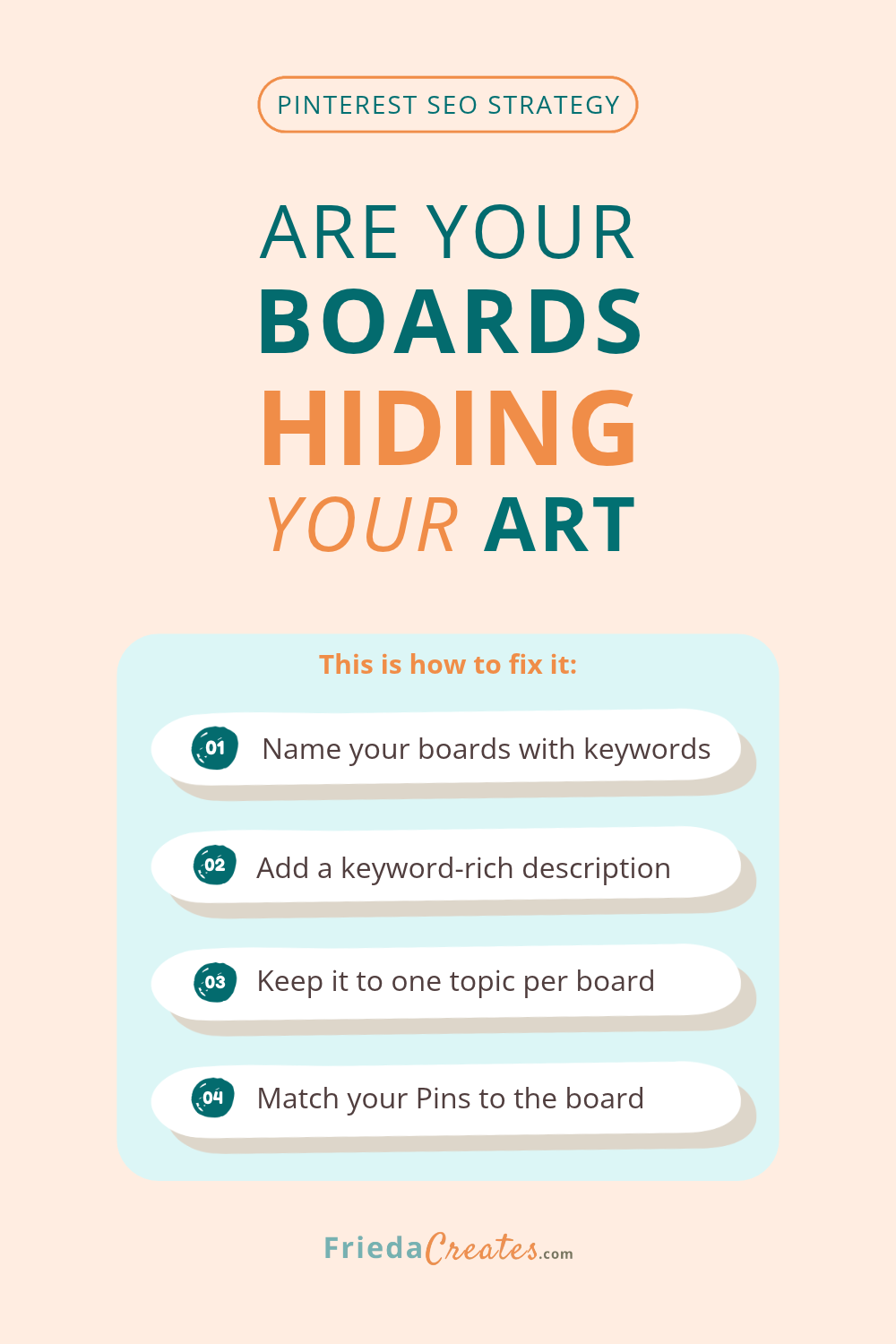
A quick board-SEO audit (do this today)
You can tune up your whole account in one sitting:
- Rename every vague board to a searchable medium-and-subject phrase (≤50 characters).
- Write a 2–3 sentence description for each, in plain, searchable language. You have up to 500 characters to write sensical, keyword-rich descriptions.
- Split any catch-all board into focused ones.
- Move stray Pins so each board’s contents match its name.
- Make off-topic boards secret (don’t delete).
- Add a clear, on-brand cover to each board.
If this feels like a lot, start with just your top one or two boards. In fact, it’s better to do less than more on Pinterest, especially if you need to change many boards. Even renaming one board is a real improvement Pinterest will read.
Recently, I reconfigured my board names and descriptions and made about 6 boards secret. I took my time making these changes, just a few each week and eventually completing the project in a month. By taking some boards offline, making them secret, you may see some of your numbers drop, after all you’re removing part of your account’s history. But bringing more clarity to my account was well worth the temporary dip.
What’s Ahead 🌿
Everything I shared above is the foundation. Behind the scenes, I’m developing a simple system that takes board SEO one step further by routing every Pin to the one board that owns its keyword, so your whole account compounds over time. It’s called The Board First System ™, and I’ll be sharing it soon. If you’d like to be the first to know when it’s ready please join my newsletter. I send practical, well-researched, Pinterest guidance for artists each month.
Would you rather hand the whole thing off? I offer done-for-you Pinterest account management for artists. I’ll build and optimize your boards, keywords, and Pins so your art gets found while you stay in the studio. See how it works →
Glossary
*SEO (Search Engine Optimization) – SEO is simply how you help Pinterest, and Google, understand what your work is about, so they can show it to the people already searching for it. On Pinterest, your SEO lives in your board names, board descriptions, Pin titles, descriptions, and even the image itself. Use the words your ideal buyer would actually type, and Pinterest connects the two of you. Think of it as labeling your filing cabinet clearly, so the right person finds your folder instantly instead of giving up.
*Taste Graph – The Taste Graph is Pinterest’s behind-the-scenes map of what goes with what, how visual styles, aesthetics, interests, and audiences connect. It’s how Pinterest “knows” that someone saving minimalist interiors might also love your neutral abstract paintings, or that a collector of botanical art is a match for your watercolor florals. You never see it directly, but it’s working every time Pinterest decides whose search results and feeds your boards and Pins appear in. Clear, consistent boards give the Taste Graph the signals it needs to place you well.
FAQ
Pinterest board SEO is naming, describing, and organizing your boards with the words people actually search, so Pinterest understands your topic and shows your art to the right audience. Your boards act as topic signals, not just folders.
Name them for what a buyer would type into search, usually medium + subject + who it’s for. For example, “Original Botanical Watercolor Paintings” or “Handmade Ceramic Vases & Home Décor.” Avoid vague names like “My Art.”
Up to 50 characters, and only about the first 21 are visible before the board is opened. Front-load your most important keywords.
Yes. Pinterest reads your board description (up to 500 characters) as a topic signal. Two or three clear, searchable sentences describing what’s inside and who it’s for will help the right people find it.
Start with about 8–10 focused boards. Enough to cover your real topics, few enough that each fills with genuinely related Pins. Tight, specific boards outrank giant catch-all ones.
Usually no. Deleting a board erases any ranking it built. Instead, rename and re-theme boards worth keeping, and make truly off-topic boards secret, it’s reversible and cleans up your topic signal.
Yes, but make a separate, fresh Pin for each board rather than saving the identical image repeatedly, and only put it on boards where it genuinely fits. This keeps each board’s topic clean.
Pinterest needs time to re-read and re-index changes, usually a few weeks, sometimes longer. Make your updates, keep pinning consistently, and let the account build. Board SEO rewards patience.